Bearing features
MONTON cylindrical roller bearings are available in many designs, series and sizes The major design differences between the cylindrical roller bearings presented in this catalogue are in:
1. the number of roller rows (one or two)
2.the type of cage (with, without or special designs)
– Bearings with a cage can accommodate heavy radial loads and peak loads, rapid accelerations and high speeds
– Full complement bearings (without cage) incorporate a maximum number of rollers and are therefore suitable for very heavy radial loads at moderate speeds
– MONTON high-capacity cylindrical roller bearings combine the high load carrying capacity of a full complement bearing with the high speed capability of a bearing with cage.
Advantage
• High load carrying capacity
• High stiffness
• Accommodate axial displacement
Except for bearings with flanges on both the inner and outer rings
• Low friction
The open flange design, together with the roller end design and surface finish, promote lubricant film formation resulting in lower friction and higher axial load carrying capacity
• Long service life
The logarithmic roller profile reduces edge stresses at the roller/raceway contact (fig. 4) and sensitivity to misalignment and shaft deflection.
Enhanced operational reliability
The surface finish on the contact surfaces of the rollers and raceways supports the formation of a hydrodynamic lubricant film.
• Separable and interchangeable
The separable components of MONTON cylindrical roller bearings are interchangeable.
This facilitates mounting and dismounting, as well as maintenance inspections.
Designs and variants
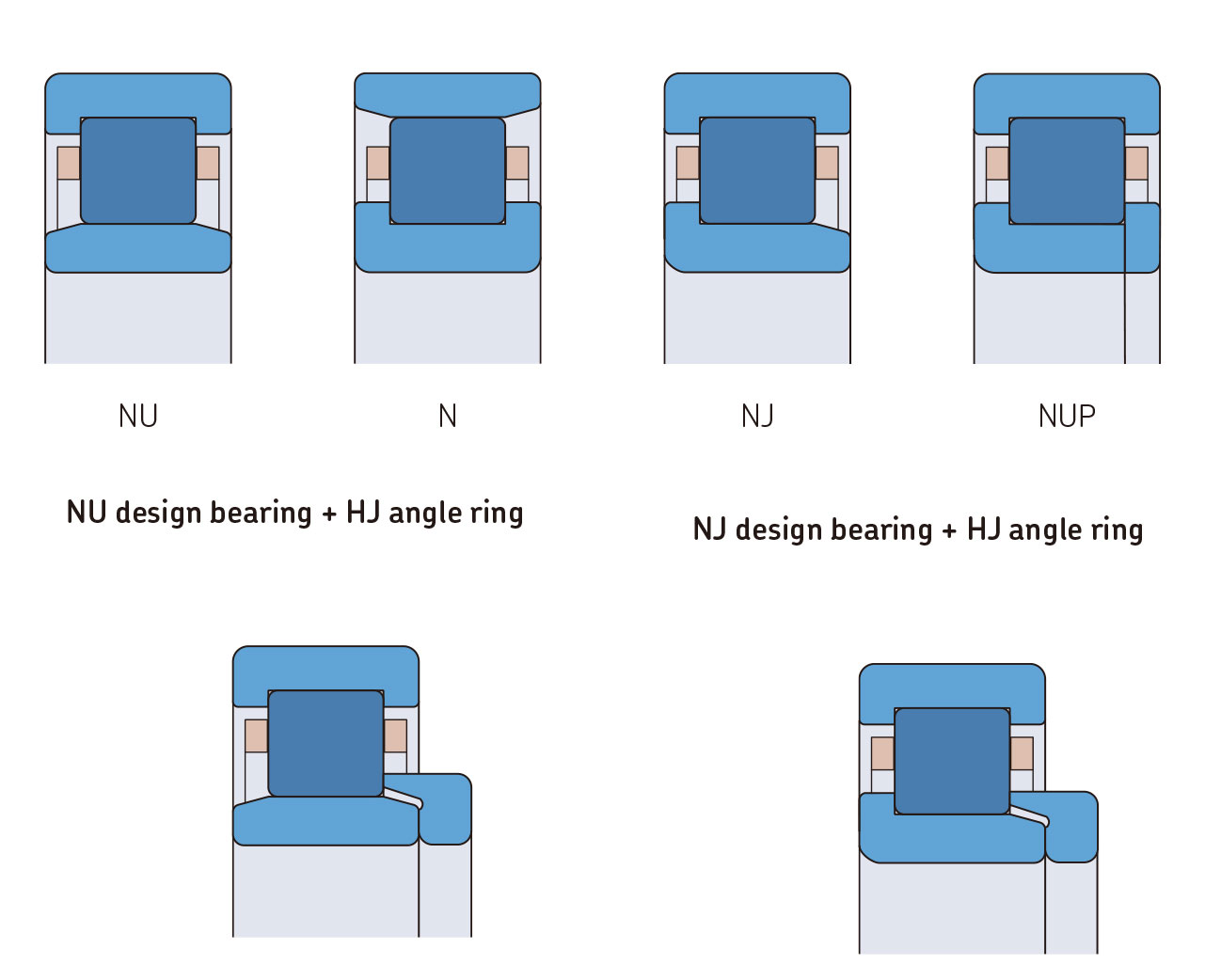
NU design bearings
• NU type have two integral flanges on the outer ring and no flanges on the inner ring.
• can accommodate axial displacement of the shaft relative to the housing in both directions.
• can be used together with an appropriate angle ring to stabilize the bearing in the axial direction .
N design bearings
• N type have two integral flanges on the inner ring and no flanges on the outer ring
• can accommodate axial displacement of the shaft relative to the housing in both directions
NJ design bearings
• NJ type have two integral flanges on the outer ring and one on the inner ring
• can accommodate axial displacement of the shaft relative to the housing in one direction only
• are used to locate the shaft axially in one direction
• can be used together with an appropriate angle ring to stabilize the bearing in the other axial direction.
NUP design bearings
• NUP type have two integral flanges on the outer ring and one integral flange and one non-integral
flange, i e a loose flange ring, on the inner ring
• are used to locate the shaft axially in both directions
Other designs
NUB design bearings
• have two integral flanges on the outer ring and no flanges on the inner ring that is extended on both sides
• can accommodate axial displacement of the shaft relative to the housing in both directions
NJP design bearings
• have two integral flanges on the outer ring and one non-integral flange, i e a loose flange ring, on the inner ring
• are used to locate the shaft axially in one direction
NF design bearings
• have two integral flanges on the inner ring and one integral flange on the outer ring
• are used to locate the shaft axially in one direction
NP design bearings
• have two integral flanges on the inner ring and one integral flange and one non integral flange, i e a loose flange ring, on the outer ring
• are used to locate the shaft axially in both directions
Bearings without an inner or outer ring
– on the shaft for RNU bearings
– in the housing for RN bearings
• are typically used in applications where hardened and ground raceways can be machined on the shaft or in the housing.

Welcome contact with us for more inforamtion!





